
What is The Steele Method?
a new way of learning

What is The Steele Method?
The Steele Method (TSM) is an intellectual training and writing workshop where 95 Rules for the good-faith rules of language are used to better understand the individual’s internal and external world.
It is through this dual lens that students are asked to write. Each essay is thoroughly critiqued by the instructor and returned to the student the same day. This cycle repeats for each class.
Students write in response to a prompt presented during 40-minutes of presentation and open discussion. The writing parameters are narrow as students are directed to submit copy of between 200 and 800-words within 20-minutes. There are no late or missed essays as students are provided the 20-minutes to write during the 1-hour class. Classes are restricted to 7-students each period and offered 3 times a day for a maximum for 21-students per day.
This is a highly demanding learning environment that provides a level of training unmatched in regular academic environments. I am consciously replicating my experience as a journalist working under an editor. I didn’t learn how to write in school as an English major as much as I was trained later on by my newspaper editor.
Teaching students how to write is labor intensive and the reason many English teachers burnout and leave teaching. There are only so many hours in a day to present and critique student writing. TSM addresses these constraints in order to provide high quality and student-focused writing feedback for each class.
The Steele Method agenda is to raise awareness, improve learning, and a foster a healthy society. When awareness is raised, learning improves, and society becomes stronger.
How does TSM raise awareness?
TSM concerns itself with awareness as it relates to the physical world. Raised awareness is accomplished by combining self-discovery with the understanding of language as a human system with multiple interacting parts. To manage all this complexity, TSM builds an epistemology from the ground up, with the rules and definitions to answer the question: What do we know and how do we know it?
To ensure that players are not distracted by the allure of absolute truth, ideas that cannot be inductively supported by physical evidence are labeled metaphysics and sequestered outside TSM without prejudice. Like all aspects of TSM, there is a step-by-step process that differentiates between physical and metaphysical ideas. One of the added benefits of differentiating between physics and metaphysics without prejudice is that it makes TSM equally open to all, regardless of religious and/or cultural beliefs.
How does raised awareness improve learning?
Raised awareness, based on applied systems theory, leads to better grades because it models how to create and understand context, the cornerstone of learning. Our brains learn through association with what we already understand. The greater the context, the higher the quality and quantity of learning.
TSM takes the next step, and uses the term applied context. Like Buckminster Fuller’s line, “God is a verb not a noun,” TSM understands context as a verb, not a noun.
For example, applied context, as practiced by TSM, is demonstrated in Code #15:
All statements must be built using the 3-Steps of Systems-thinking:
List all the parts of the system
Determine if the system is open or closed
Observe the interaction between the system’s parts.
These three steps represent the science of creating and managing context—applied context in action.
Step 1 begins by listing all the parts of a set. This raises the question: What is a part? TSM understands the parts of a set as the physical evidence that makes up the whole set. That definition in turn begs the question: What is the nature of being holistic? Furthermore, each part must first pass the Steps and Tests of Discovery before being included in the set: the point being that listing the parts of a system, just by itself, is a complicated and demanding process.
The nature of evidence, the do’s and don’ts of listing all the parts of a set, is laid out in TSM by Rules 5-9.
TSM produces better grades because it teaches how to build and manage context. For those that already max out the grading scale, complete this course and academic work will become easier and more fulfilling. Complete this course and you will show up at university freshman year better prepared than the competition.
Understanding language as a human system includes the human condition. Human language, the use of agreed-upon abstract symbols and sounds to convey meaning, is a creation of the human mind. If there is no one in the room, there is no language. Having the capacity for language as described by linguistics is not the same thing as practicing language—you cannot practice human language without a living human.
If humans are an essential part of language, then it is impossible to separate language from the human condition. Who you are is a part of your use of language, the way you perceive your own use of language, and the way you perceive the use of language by others. In this way, self-knowledge becomes a central part of language. The better you know yourself, the more you will understand about your use of language, and the use of language by others.
Self-knowledge is so important to TSM that it forms the third rule: “The essence of knowledge is self-knowledge.” Starting with Rule 3, each of TSM’s 95 Rules has a component for practicing self-knowledge. There are few academic settings that apply the quest for self-knowledge daily and in a specific context, as applied by TSM. By posing the question “Who am I?” in various ways and repeatedly, one inevitably gains a deeper understanding of oneself. More importantly, the result of such self-inquiry instills a lifelong practice of constructive self-discovery.
How can improved learning make society stronger?
The third promise for those that complete this course is that it equips the student with the skills to create positive change. An understanding of self, coupled with a detailed understanding of language, puts the practitioner in a position of creating positive change, because they now have the skill-set to envision, design, build, and successfully operate new human systems. This is the result of TSM: once you understand language as a human system, that knowledge allows you to go and lead others in creating new human systems.
Scholastic Deficiency
High-school English is significantly deficient on two fronts: we are failing to teach students the nature of language, while simultaneously failing to teach epistemology—that is, how we know what we know. A solution to these deficiencies is TSM and its focus on language as a system in the context of change.
Since the advent of modernism, great strides have been made in the areas of language and knowledge. Unfortunately, few of these advancements have made their way into US high-school classrooms. Instead, we have four years of language arts, when what we need is a balance of art and science.
The deficiencies in high-school English are glaring when compared to high-school science. There was an explosion of new ideas at the beginning of the twentieth century, so that virtually every academic discipline underwent a major transformation, and the science of physics was no exception. A review of high-school physics standards demonstrates the legacy of these early twentieth-century transformations. The following people and ideas appear either directly or indirectly in secondary science curricula throughout the US:
Max Planck (1858–1947) Planck’s work on quantization of energy and the concept of quantized energy levels laid the foundation for quantum mechanics. This is often covered in secondary science curricula when discussing the photoelectric effect and the nature of light.
Erwin Schrödinger (1887–1961) Schrödinger’s wave equation is a fundamental concept in quantum mechanics, describing the behavior of matter waves. This is often introduced in secondary science curricula when discussing wave-particle duality and the behavior of particles at the atomic and subatomic levels.
Louis de Broglie (1892–1987) De Broglie proposed the concept of wave-particle duality, suggesting that particles, like electrons, can exhibit both wave-like and particle-like behavior. This is closely related to Schrödinger’s work, and is usually covered in secondary science curricula when discussing quantum mechanics.
Werner Heisenberg (1901–1976) Heisenberg’s uncertainty principle, which states that certain pairs of physical properties cannot be precisely determined simultaneously, is a central concept in quantum mechanics. This is often discussed in secondary science curricula when covering the limitations of measurement at the quantum level, and the philosophical implications of uncertainty in physics.
Although there was a similar explosion of new ideas relating to language around the beginning of the twentieth century, the English Common Core makes no mention of the following people, their ideas, or any of the academic developments since then—as if the twentieth century never happened. Putting aside the Common Core’s failure to mention the Greeks, Thomas Aquinas, or John Locke in the context of language, the Common Core makes no mention of those who helped shape the modern era of language theory and epistemology, such as the following:
Friedrich Nietzsche (1844–1900) introduced the idea that language is a series of disjointed metaphors, and that this metaphorical nature prevented language from representing universal truth.
Sigmund Freud (1856–1939) developed a comprehensive theory of the mind where language plays a crucial role in the expression of thoughts and desires. Freud explored how linguistic expressions manifest in the different layers of consciousness. He also emphasized the symbolic nature of language, asserting that symbols and metaphors are crucial for understanding unconscious processes.
Ferdinand de Saussure (1857-1913) is regarded as the father of structural linguistics, and is responsible for introducing such concepts as: sign and signifier, the arbitrary nature of the sign, the difference between diachronic (historical) and synchronic (contemporary) linguistics, and the understanding of language as a social construct.
Roman Jakobson (1896-1982) introduced a language model that provided a comprehensive framework for analyzing language functions in communication, emphasized the analysis of language as a system of interrelated elements, contributed to the development of linguistic typology—the classification of languages based on their structural features—and made significant contributions to semiotics, where he emphasized the importance of examining how signs function in various contexts, and how they convey meaning.
Karl Popper (1902-1994) emphasized the importance of falsifiability as a criterion for scientific theories, and he developed the concept of evolutionary epistemology, which explores the evolution of knowledge. Popper advocated for critical rationalism, a position that emphasizes the fallibility of human knowledge, and the importance of constant criticism and revision of theories.
Roland Barthes (1915-1980) contributed to the understanding of language as a system of signs, while analyzing various aspects of contemporary culture and mass media. He used this analysis to reveal the hidden ideological meanings embedded in everyday signs and symbols. Barthes challenged the traditional view of authorship, arguing that the authority of the author should not overshadow the reader’s interpretation and experience of a text. He also challenged the notion of isolated, self-contained works, and contributed to a broader understanding of knowledge as a network of interconnected ideas.
Jacques Derrida (1930-2004) is the father of deconstruction, a philosophical approach that investigates traditional notions of binary oppositions, hierarchical structures, and fixed meanings in language. He introduced the term différance to highlight the dual nature of linguistic signs. Derrida also questioned the classical understanding of the sign and signifier, arguing that meaning is not fixed, and that signs are always evolving.
Except for Barthes’ view of authorship, there is no mention of the above contributions to the modern understanding of language in the Common Core. It is not hyperbole to conclude that today’s Common Core English standards would feel as much at home in a classroom 150 years ago, right next to the McGuffey Readers, as they do today. The result is a population made less aware about the very tool necessary for thinking and communicating.
Any claim that language theory is too complicated or controversial for the high-school classroom is utter nonsense. I challenge anyone to identify any portion of present-day language theory that comes even close to the intellectual demands and controversy generated by the inexplicable but observable reality of quantum entanglement—or even Algebra I (Rosenblum).
A great deal can be said about why high-school science has kept up with the advancements in research while high-school English has not. However, that is not the point of this book, or of TSM. Rather, this approach to language study is concerned with taking stock of where we are now, moving forward by providing an understanding of language, and offering an epistemology that is accessible to the average sixteen-year-old.
The Steele Method and Language Theory
Why is teaching language theory so important? Because it is through the discipline of language theory that language can be discussed successfully as a whole system of interacting parts. The wholeness of language as a system, the listing of the many parts of language, is supplied by all the accomplishments of those theorists, beginning with the ancient Greeks, who helped develop what is today a complex understanding of language.
Beyond the merely rational, to understand language is to free the mind to wonder. Consider the impact of Albert Einstein’s theory of general relativity, not just on physics and the other sciences, but also on the larger public imagination. While Einstein was challenging Newton’s laws, literature and poetry were being revolutionized respectively by James Joyce and T. S. Eliot. At the same time, Pablo Picasso was busy changing the nature of line and perspective, while Henri Matisse was changing the way we think about color. In music, tonality was forever being changed by Igor Stravinsky and Arnold Schoenberg.
The world of wonderment brought on by the likes of Einstein, Planck, and Heisenberg provided physics with thought experiments—still used today to push the envelope of physics by suggesting further areas of research.
If wonderment fosters a greater understanding of physics, then why can’t wonderment do the same for language? By failing to teach the nature of language in high school, we are foregoing all the unknown advances that could come from a better understanding of the very tool we use to think and communicate.
Then there is the practical side of things. Teaching the nature of language is also important because it enhances problem-solving skills. The first step of analyzing a system is to discover all its parts. This also happens to be the first step of problem solving: understanding the context of a problem by discovering all the influences relating to some dysfunctional outcome.
Additionally, teaching the nature of language protects the individual and group from those who covertly manipulate language for profit and power. TSM’s treatment of systems theory explains why the manipulation of language undermines the ability of human systems to achieve purposefully-set goals, and TSM’s treatment of propaganda explains how this undermining of language is accomplished.
The political ramifications of teaching language as a system can be found in the contrast between Plato’s concern for Who should rule? and Karl Popper’s question of How do we arrange our institutions to prevent rulers (whether individuals or majorities) from doing too much damage? While Plato is concerned with the politics of who is elected, Popper is concerned about the corrupting influence of human nature, regardless of who is elected.
Learning about the nature of language in the context of systems theory provides more information, along with the tools for managing this increased volume of information, which results in increased overall awareness—not to mention better grades and a greater sense of self.
The Steele Method and Systems Theory
A common theme throughout the modern era was the replacement of the simple with the complex. In every example of modern thinkers, the respective disciplines were expanded or created to be understood not as a grouping of individual and autonomous parts, but as systems of interacting parts. The modern era is full of such examples, including the parallel development of atomic and language theories.
At the beginning of the twentieth century, the smallest unit of matter was the individual atom; likewise, the smallest unit of language was the individual word. Both disciplines underwent a fundamental change as atoms became understood not as autonomous individual things, but as systems of interacting parts. In the same way, modernism ushered in an era in which language itself was no longer considered to be comprised of individual words, but was now understood as systems of interacting parts.
In both linguistics and physics, the classical notion of difference gave way to the more sophisticated interactions of systems. TSM explains the role difference plays in meaning, and the way in which, upon closer inspection, differences of meaning are interconnected through a relationship of opposing parts that make up a whole.
If A cannot exist without B, when A and B represent a relationship between two sides of the same coin, then how do you separate A from B for the purpose of defining their difference?
The same concept is alive in physics, where the parts of an atom are understood not to be autonomous, but to exist as the result of relationships. A similar analogy can be found in the elements of time, space, and matter, all existing as a relationship of parts. Writing in 2015 for Scientific American Magazine’s issue celebrating 100 years of general relativity, Walter Isaacson explains:
With his special theory of relativity, Einstein had shown that space and time did not have independent existence but instead formed a fabric of space-time. Now, with his general version of the theory, this fabric of space-time became not merely a container for objects and events. Instead, it had its own dynamics that were determined by, and in turn helped to determine, the motion of objects within it.
Similar expansions of understanding during the modern era applying a systems approach include the following:
Sigmund Freud expanded the understanding of the human psyche to include a system of three interacting parts: the Id, the Ego, and the Superego;
Karl Marx, pushing back against the self-serving economic models of his day, insisted that economics be understood as a whole system that must include all relevant parts, including labor;
Ferdinand de Saussure explained how words (signs) are not isolated units, but are comprised of interacting parts, the signifier and the signified, that interact like two sides of the same coin.
Roman Jakobson created a model of communication that understood language as a system with six interacting parts: referential, expressive, conative, phatic, metalinguistic, and poetic.
The application of systems theory to language is particularly significant for TSM because of the role played by the individual. TSM’s primary structure of language is the interplay among three forces:
the linguistic Operation of language
the human nature of the Operator of language
the Rules mitigating the relationship between the Operator and the Operation of language
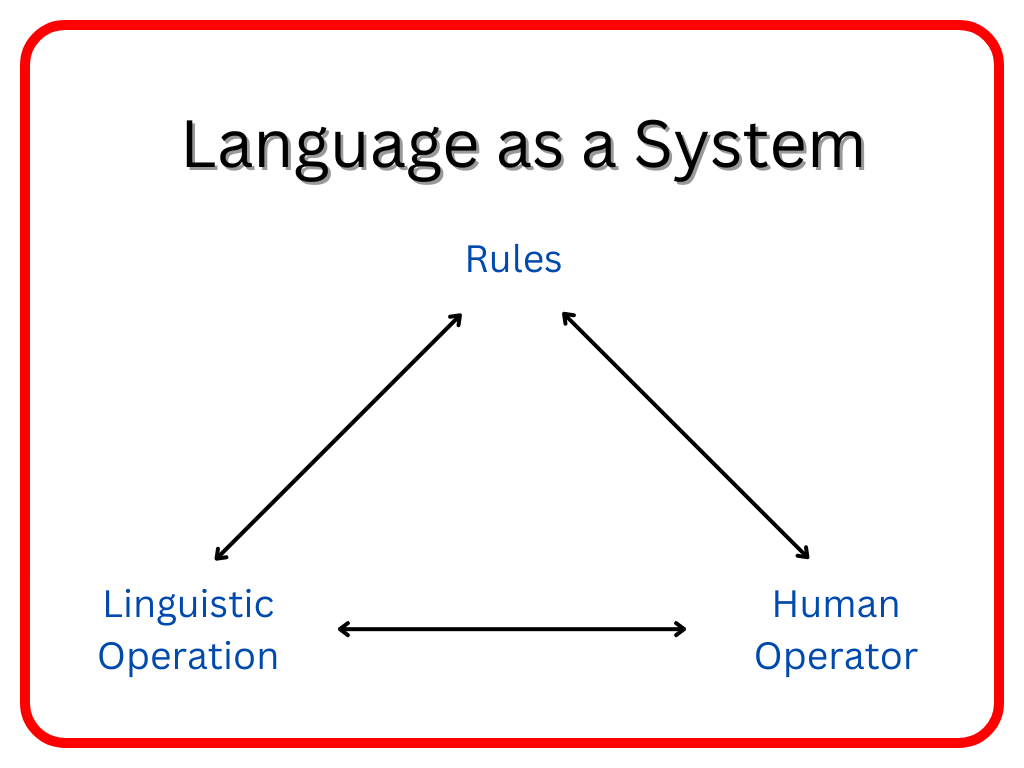
Language as a system of interacting parts
TSM presents these three competing ideas as its primary learning structure, which is represented by a triangle of competing forces where each element stands in a collective relationship of tension and balance with the other two. Human nature is an essential part of language because language does not meaningfully exist outside of its use. Therefore, it is not possible to separate the human mind from its use of language.
Systems theory demands attributes that keep the human Operator in check. These attributes include the following:
Wholeness
Accountability
Transparency
Integrity
Balance
Sustainability
It is through the demands of systems theory that human tendencies to cut corners in the pursuit of self-interest are kept at bay, in service to the system’s purposeful goals. Systems theory does not make these demands because of some moral or ethical code, but because of self-interest built from heightened awareness of the greater whole. By incorporating these ideas into TSM, students learn through the practice of process, rather than by the memorization of content.
Despite the complexity of all these systems, the most complex of all systems is that which accounts for our internal selves. This complex system of self-knowledge is also directly tied to learning. Therefore, TSM begins with the question Who am I? Incorporating quotes from virtually every major thinker throughout world history, TSM requires each player to ask Who am I? throughout the training.
The modern era ushered in an awakening to the idea that understanding was not a product of difference, but a product of a far more complex set of relationships that are forever in a state of change. It is systems theory that provides us with the tools to comprehend and manage this new world of constantly-changing and complex relationships. Through the work of famed Austrian biologist Ludwig von Bertalanffy and his book General System Theory, TSM focuses on the introduction and formal development of systems theory in the twentieth century to build its framework.
Propaganda is the bad-faith use of language
TSM presents a set of rules that define the good-faith rules of language use. Once these good-faith rules are defined, TSM is equipped to demonstrate that propaganda is the intentional subversion of these good-faith rules. For the propagandist, TSM’s Rules of Discovery and Logic are not defining parameters that limit and guide language use as it relates to the physical world, but are a proactive part of the propagandist’s tool-box for manipulating language in the service of the agendas of those who pay.
Change, Infinity, and Social Constructs
There are 3-characteristics of language and the human condition that TSM argues are structurally true:
Change is constant.
The physical moment is infinite.
Language itself is a social construct.
TSM considers these 3-concepts to be foundational to the larger epistemology.
The concept of epistemology has historically been used as a top-down system for control. Socrates pushed back by advocating for independent inquiry, using the individual’s 5-senses to collect data, and the brain for analysis and understanding. TSM attempts to replicate this approach, using what has been learned about language and human nature in the subsequent 2-millennia.
Socrates was accused of impiety (disrespecting the gods recognized by the state) and corrupting the youth of Athens by encouraging them to question and criticize established norms. Socrates was considered a threat by the ruling class, because he advocated for a decentralized individual pursuit of knowledge, in contrast to accepting the truth provided by the centralized ruling class, via religion. It was clearly understood that those who control epistemology control society, and Socrates was a spoiler.
Plato responded by introducing the concept of ideal Forms that existed in heaven, so as to avoid the fate of his teacher Socrates. The Forms represented unadulterated permanent truth, which was interpreted and dispensed by the gods via state-sponsored religious authorities. In this way, the Greek ruling-class controlled truth—and in turn, controlled society.
Aristotle attempted to create a middle ground by reviving Socrates’ reliance on physical evidence, but without negating the authority of the state.
The Catholic Church carried on this tradition of using a centralized epistemology for the purpose of control. Plato’s Forms represented ideal truth, which allowed the ruling class to play intermediary between heaven and earth. The Catholics liked Plato’s model because it facilitated their claim of godly authority on earth. This is metaphysical sleight of hand whereby the human ruling class, caught in the finite trap of language, can claim the power and authority of the infinite gods. In both instances, the Greeks and the Catholics believed in 1) immaterial and eternal truths; and 2) a set hierarchy of knowledge. With these tools of authority, the Catholic Church was able to subjugate Western civilization for 1,500 years. It wasn’t until John Locke challenged Plato’s notion of Forms that the reign of the Catholic epistemology started to give way in the 14th century.
TSM embraces the unknowable by championing 3-forces: change; the infinite physical moment; and language as a social construct. The most substantive difference between the epistemology of TSM and that of the Greeks and Catholics is that the latter facilitated fixed universal truths that originated from the gods, or God, respectively. This is why the notions of change, infinity, and language as a social construct are so important to TSM: all 3-concepts emphasize what is not knowable in any fixed, universal way.
Change: “The physical world is in a constant state of change” is the first rule of TSM. This rule is antagonistic to any notion of understanding universal truth. What is true today may not be true tomorrow, because things change.
Infinity: “The physical moment is infinite” is the second rule of TSM. Like the constant changes in nature, the infinite nature of the moment is also antagonistic to any claim of universal truth.
Language as a social construct: The meaning, spelling, and pronunciation of a word is the product of social agreement. There is no such thing as a natural word, with the possible exception of onomatopoeia—which, if true, makes it an exception to the rule. The plethora of different languages demonstrates the point that there is no original word for (say) rock, from which all languages derive their word for rock.
Ok, so now what do you do?
Given the above 3-concepts about language, how is anyone supposed to know what is true?
This is the big question of TSM: how do we figure out what is true, given the absence of fixed ideas? The answer is that we have 2-options: 1) accept what we are told by authorities, either religious or secular (centralized); or 2) determine what is true individually (decentralized).
There is a third way: collectively agree on a transparent epistemology that is open to revision, so that everyone can share equally in the tools of knowledge, while avoiding the pitfalls of relying on others to provide knowledge and analysis. It’s not about having the correct epistemology, but about embracing the epistemological process, and being consistently aware of the methodology being used.
By eliminating fundamental fixed ideas, TSM transforms the very notion of epistemology, from being a centralized tool of control to becoming the antidote for tyranny, by decentralizing the process of determining truth—all the while improving academic performance.
Process over Content
Fundamental to TSM is the championing of process over content. How do you teach and test for an idea that is defined as a moving target? But, more fundamentally, how do you teach change when the answer itself might conceivably change between now and Friday’s quiz? The answer is to teach process over content so that the lesson is not the memorization of individual academic units, but the practice of processes. This notion of content versus process is essential in order to understand TSM: process is not the elimination of content, but the act of determining and managing content.
Augmenting this structure of championing process over content is the characterization of all TSM’s ideas as tools. These tools are like those found around the house, in that they require the following:
Training
Skill-building
Maintenance
Replacement
In this way the ideas (or tools) of TSM accommodate change.
The first tool of TSM is the question Who am I? This question is a perfect example of a tool because of the way it represents process over content. You have to be honest with students, and acknowledge that the question of self-knowledge can never be fully known, no matter how much effort an individual puts into their investigation. Therefore, the question of self-knowledge is not a thing with a beginning, middle, and end; or an element of content; but a tool of process. And because change is constant, the process of asking the question—the tool itself—will evolve as the individual evolves.
The notion of wholeness provides another good example of a tool. Systems theory requires that practitioners seek to account for all elements of a system, so as to understand the whole system. But, of course, it is not possible to know whether all parts have been accounted for, because that would require omnipotent knowledge of all places and times. Therefore, the tool of wholeness is not a thing, but a process for making a best effort at accounting for all the parts of a system.
TSM’s rules are themselves tools, as is evidenced by the first rule: “The physical world is in a constant state of change.” This emphatic statement is intended to challenge the player. All a player needs in order to challenge this statement is to find a single contradictory example. As players rack their brains, trying to think of a way to prove this statement wrong, they are learning process. When players think that an example of stasis in nature has been found, and attempt to apply the example—only to fail—they are learning process.
Encouragement of Change
Further complicating the discussion of change is the question of how to teach process when even the process itself is susceptible to change. TSM satisfies this quandary, not only by accommodating change, but also by proactively encouraging students to challenge the Rules. Students use the Rules, along with outside evidence, to demonstrate examples of inconsistency within TSM.
Putting students in a position of academic authority is potentially problematic, as lessons could become untethered from their evidentiary foundations, and drift off into meaninglessness. The answer is facilitated by a demanding academic process:
Identify. In what way does the Rule need to be changed?
Solve. How should the Rule be changed?
Argue. Why should the Rule be changed?
Support. Provide evidence to support your change.
Conclude. Advocate for your change in a single sentence of fewer than twenty-one words.
The ideal execution of TSM includes a daily back-and-forth exchange of text between player and teacher, which effectively provides players with a private writing coach throughout the training’s four-month cycle. This can be configured in multiple ways. For instance, a parent could use this book, or related videos, and serve as the student’s writing coach, critiquing daily essays.
This is how to teach writing: practice, practice, and more practice, with a tutor looking over the student’s shoulder, and providing advice on a daily basis, for a semester. This is why so many of the twentieth century’s greatest authors started out in journalism, because every journalist has an editor. Deployed in this way, TSM provides each player with a level of writing instruction that is even better than a private tutor, because the roles of writing coach and a daily video show are kept separate; this allows for a team of educators to focus on different specific tasks.
The encouragement of players to challenge the Rules is an intentional act of tapping into youthful angst. There is no greater motivator of learning than explaining how authoritative ideas are possibly wrong, incomplete, or hypocritical.
The Steele Method and Education Theory
The notion of wholeness as described by systems theory goes to the heart of what is known about learning theory: namely, the building of context. Learning is directly tied to context, because it is through context that the human brain creates memory—the greater the context, the greater the quality and quantity of the learning experience.
To put it simply, a well-crafted lesson begins with what the student already understands (point A), and then moves in small digestible steps to the lesson objective (point B), without ever letting the student feel adrift from point A. By formally incorporating the tool/study of wholeness into the classroom, the instructor strives to maximize context.
Another reason that context is tied to learning is because humans learn in different ways. Context provides greater complexity, and thereby more ways for accessing the same set of information. The value of studying a system is not to gain a greater understanding of the system’s parts, but to learn from the relationships, or interactions, between the parts. It is the study of relationships that opens ideas up to the various modes of learning. In this way, learning theory and systems theory share important characteristics.
Additional structures found in TSM read like a checklist of education theory stretching back over the last fifty years. Jean Piaget (1896–1980), the father of developmental psychology, had a significant impact on learning theory, specifically with regard to creating learner-centered models. Kenneth Henson, writing in his essay Foundations for Learner-centered Education: A Knowledge Base, lays out a number of practices based on Piaget’s research that include the following:
Providing experience-based educational opportunities,
Contemplating the learners’ individual qualities and attitudes during curriculum planning,
Allowing learners’ insights to alter the curriculum,
Nourishing and supporting learners’ curiosity, and
Involving learners’ emotions and creating a safe learning environment.
Providing Experience-Based Educational Opportunities: TSM equates experience with discovery, in that students discover (on their own) ways in which TSM can be changed. In this way players gain real-life experience of using the world of ideas to effect meaningful change.
Contemplating the Learners’ Individual Qualities and Attitudes: TSM is designed to reach a broad spectrum of players, from mainstreamed sixteen-year-olds to undergraduates, law students, and beyond—including corporate executives looking to up their game. The design is based on one simple idea per daily Rule, each of which is accessible to all. From this simple and accessible point, complexity is added.
Allowing Learners’ Insights to Alter the Curriculum: TSM’s encouragement of student challenges is a real-world level of altering the curriculum.
Nourishing and Supporting Learners’ Curiosity: Each class includes some current event as a way of demonstrating the Step’s lesson. The background of these events is supported by numerous documents and links. If players choose, they can spend considerable time reading the outline, PowerPoint, news links, and PDF articles related to a specific Rule.
Involving Learners’ Emotions and Creating a Safe Learning Environment: TSM’s direct approach to self-knowledge is specifically tied to student emotions. This approach is more than making an inventory of the self and incorporates proactive ways to understand and interact with the way the unconscious can manipulate emotion. The end result are students who are more aware ofd their inner self and by extension more confident.
Piaget himself said it best when he commented:
Education, for most people, means trying to lead the child to resemble the typical adult of his society…but for me and no one else, education means making creators… You have to make inventors, innovators—not conformists. (Bringuier).
Piaget was also focused on the relationship between learning and morals, and believed in two basic principles related to moral education:
1) children develop moral ideas in stages, and
2) children create their own conceptions of the world.
Piaget argued that morality is best developed through peer interaction, and not through learning from a top-down external authority (Piaget). TSM specifically models this approach to morality through its rules (Codes), which are based on observing the physical world, and are designed to mitigate the impact of human nature on language. These rules must be justified by TSM itself, and are open to player challenge.
Connections: TSM is about learning a process for understanding the infinitely complex world of connections. Once two parts of a system connect or interact, a new, third system part—the outcome—is created, in an often-unpredictable process. In this way, systems theory can be described as the study of multiple layers of interconnections that can quickly develop in a nonlinear manner.
Flexible Pacing: Daily classes are designed to be created fresh each day so as to capitalize on the going-on-now capacity of current events related to energy, war, and the environment. Therefore, the best way to learn TSM is to complete each class on the day it becomes available. If players fall behind, they can catch-up through recorded video of past classes.
Transdisciplinary Inquiry: TSM incorporates the numerous disciplines that influence language, including the following:
Writing
Linguistics
Philosophy
Ecology
Education
Physics
History
Politics
Psychology
Economics
Meta-learning
Writing in the British Journal of Educational Psychology in 1985, John Biggs defined meta-learning as a state of “being aware of and taking control of one’s own learning.” TSM’s encouragement of students to challenge a Rule directly satisfies Biggs’ call for students to experience academic control. Beyond passively facilitating this meta-learning experience, TSM proactively encourages players to effect change by awarding points for their efforts.
The Steele Method and Practice
TSM creates a strict learning environment, in the same way that a sports coach creates training exercises within parameters narrower than those found on the playing field. Specifically, TSM requires that all arguments be based on evidence from the physical world, and derived through the five senses. In this way, TSM forces players to develop specific skill-sets. Through the Rules of Discovery, players are introduced to the distinction between the physical world of the five senses, and the metaphysical world born of the imagination and untethered from the constraints of physical evidence. It is in this context that metaphysics is defined and placed outside of TSM without prejudice. Metaphysics isn’t wrong, it just exists outside the parameters of TSM.
Clearly, I am not using the term metaphysics in a way that specifically tracks Aristotle’s work by the same name. I’m also not using the term in the same way as Derrida and other post-structuralists use the term. Here, I am using the term in specific juxtaposition with physics so as to create a simplistic distinction between thoughts based solely on physical evidence (physics), as opposed to ideas that are born of the imagination (metaphysics). Such distinctions are used for the express purpose of training students to intellectually perform within a very narrow range of thought.
Think about the football coach who trains players using old rubber tires laid out flat in a pattern. Players are required to run over the tires, with knees high and with the balls of their feet hitting the center of each tire, as a form of training to improve power, agility, and speed. Obviously, there are no tires on the actual field of play. In the same way, TSM trains players using binary thought structures to promote strength, speed, and agility of thought. To use the physics vs. metaphysics duality as an example, there is nothing about the way this TSM defines metaphysics that prevents a sixteen-year-old playing TSM today from gaining a more nuanced understanding of Aristotelian metaphysics later in college.
TSM introduces the parts of language in the following order:
The Parts of Language
Change
Self-knowledge
Rules of discovery
Systems theory
Human nature
Rules of language
Language theory
Logic
Propaganda
These parts of language are not an attempt to provide a final answer as to what constitutes the full relationship between language and truth, for it is possible that such a question can never be answered. My hope is that this effort will motivate others to build competing models. Observe the following, and your efforts will be fruitful:
Thou shalt not discriminate against the inclusion of a system element based on any form of ideology.
Every act must be in service to the rules and goals of the system.
Always honor change.
Conclusion
Nothing about the ideas presented here is original. The key point is that teaching students about the nature of language and systems theory can be a straight-forward process, no more difficult than teaching Algebra I. Teaching the nature of language only seems difficult because academia has made no effort to make these ideas accessible to the general public.
The cause of academia’s negligence—why we do not teach the workings of language in a clear and generally accessible way—is unclear. One possible explanation is that the increase in overall awareness provided by studying language is inversely connected with the success of the Language Manipulation Complex (LMI), comprised of advertising and its sister industries of communications and public relations. Financial powers are structurally opposed to the teaching of an applied systems theory because of the context it creates. Systems theory exposes the whole of the set which, in the case of language, includes exposing the role that financial powers play in the larger context of society, along with how their centralization distorts/marginalizes the democratic process. Applied system theory pressures the centralized to decentralize, not for ideological reasons, but because we can see the evidence, and can subsequently reason that centralization is antithetical to a balanced and stable system.
The negative impacts of centralization are accentuated in the context of human nature. Where is an academic who effectively attacks the value of an advertising dollar going to go and get grant funding? What academic is going to advocate in the classroom for a perspective that antagonizes corporate university funding? Academics are inherently tied to funding, one way or another, and those sources of funding are inherently reliant on advertising. These financial forces inform academic culture and shape it with particular vigor, because the whole of academia, from associate professor to the university president, is impacted by donations, and understands the need to keep donors happy, while avoiding internal bureaucratic controversy.
TSM is the antidote to the manipulation of language on behalf of financial interests, just as it is the key to learning. In both instances, the good-faith focus on context is the engine of learning and transparent accountability.
Bibliography
Bringuier, J.-C. 1980. Conversations with Jean Piaget (transl. B.M. Gulati). Chicago: University of Chicago Press. 132
Biggs, John B. 1985. The Role of Meta-Learning in Study Process. British Journal of Educational Psychology 55: 185–212. http://onlinelibrary.wiley.com/doi/10.1111/j.2044-8279.1985.tb02625.x/abstract
Henson, Kenneth. 2003. Foundations for Learner-Centered Education: a Knowledge Base. Education 124 (1): 5–16. https://go.gale.com/ps/i.do?p=AONE&u=googlescholar&id=GALE%7CA108911198&v=2.1&it=r&asid=1fcf985b
Isaacson, Walter. 2015. How Einstein Discovered General Relativity amid War, Divorce and Rivalry. Scientific American. September 2015: 44. http://www.scientificamerican.com/article/how-einstein-discovered-general-relativity-amid-war-divorce-and-rivalry/
O’Leary, Brian. 2012.
Piaget, Jean. 1932. The Moral Judgment of the Child. Glencoe, Illinois: The Free Press. 113
Rosenblum, Bruce, and Fred Kuttner. 2011. Quantum Enigma: Physics Encounters Consciousness. Oxford: Oxford University Press. 87
Skinner, Burrhus F., and James G. Holland. 1961. The Analysis of Behavior: A Program for Self-Instruction. New York: McGraw-Hill. 380