
THE HUMAN EXPERIENCE COMPOSITE
reluctantly coining a phrase

For centuries, philosophers and scientists have tried to describe the whole of human experience. Some have focused on consciousness, others on the unconscious, and others on the limits of our senses or the vastness of what lies beyond them. Yet almost all of these models, no matter how systematic or insightful, eventually reach a point where they lean on mystery. Whether it’s framed as a soul, a divine order, a cosmic principle, or an ineffable realm, metaphysics has been the fallback when the limits of language and analysis become apparent.
What stands out in present day is the different ways two sciences treat the unknown. Quantum physics includes observable outcomes that defy explanation. Two examples are entanglement and the observer effect. Quantum physics does not get hysterical when it can’t explain something.
However, when you look to the current practice of psychology, there is little to no mention of Carl Jung and the unconscious. Psychology labels Jung irrelevant because he “believed in religion.” This is so misguided it is suspect. Jung was trying, like a poet, to use language to accomplish the impossible, use finite language to explain the infinite unknown. How do you explain how humans share innate psychological traits across cultures? These cross-cultural traits are observable but there’s no physical evidence to explain it. Because of this gap in understanding, psychology tells us there is nothing to see, and if necessary, go ask your priest.
The Steele Method manages the unknown by accepting the possibility of future physical evidence and understanding. If we don’t know then the policy is to stay a safe distance and neither underestimate nor overestimate the situation. There is no need to personify or anthropomorphize the unknown because there’s nothing in tension with it. The unknown simply exists until we get better information. This allows for a thorough evaluation of the evidence right up to the unknown, just like working around the unknown is practiced in quantum physicists. At no time is speculation about the unknown used as evidence to support any idea or construct.
This approach allows us to construct a complete model of human experience that remains firmly grounded in the physical and observable while providing space for the unknown in a way that doesn’t generate any ambient distortion.
This respect for, and willingness to coexist with, the unknown avoids metaphysics by treating the limits of language and the mysteries of the unconscious not as puzzles to be solved but as a structural fact of life
.
Definition
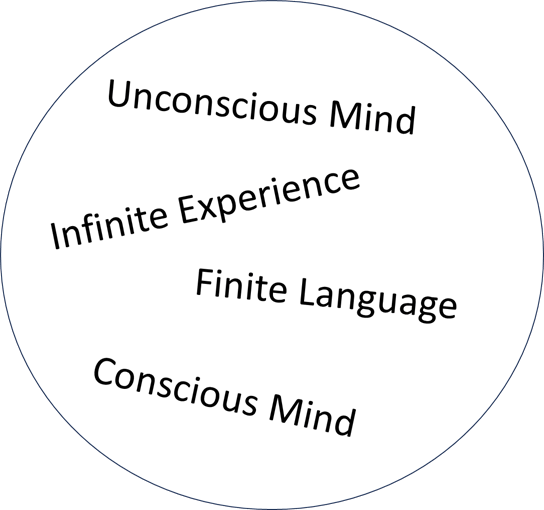
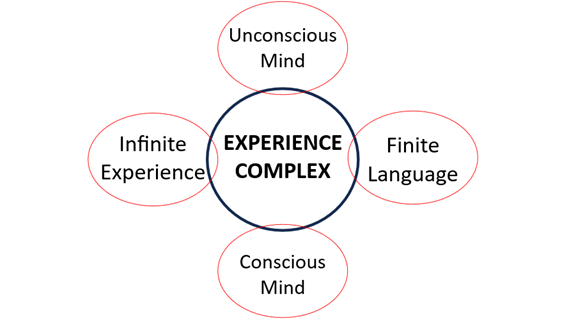
The experience-composite is a complete system representing all of human experience. It is composed of two structural bounds and two processing forces:
STRUCTURAL BOUNDS
Infinite experience represents our emotions, sensations, and intuitions before we use language, before we think. Thinking shapes the experience, meditation is experience in the absence of language.
Finite language represents symbols of infinite experience bound by the nature of language.
PROCESSING FORCES
The conscious mind is the slower part of the psyche that is aware of the present moment, including thoughts, perceptions, and feelings that one can directly experience and control. It involves the ego, which is the center of conscious awareness and identity.
The unconscious mind is the faster, broader and deeper part of the psyche that shapes most perception and decision-making. It contains all the thoughts, memories, and feelings outside of conscious awareness. Synonyms for the unconscious include: intuition, instinct, synchronicity, conscience, gut and soul.
There are 2-layers to the unconscious:
Personal Unconscious is the part of the unconscious generated by our life experiences that holds forgotten or repressed personal experiences and memories unique to the individual. Jung coined the term shadow and complex for aspects of the personal unconscious that are repressed or hidden.
Collective Unconscious, the soul, are those characteristics representing universal patterns of behavior and cognition that provide automatic, patterned processing using images, symbols, and feelings. Like quantum physics, the collective unconscious includes outcomes that defy explanation.
The spectrum of human nature is generated by Characteristics and demonstrated by universal Types:
Characteristics
Persona
The Persona is the social mask. It represents how an individual adapts to social expectations and roles. Necessary for functioning in communities, it can also become rigid, hiding aspects of the true self that do not fit acceptable identities.
Shadow
The Shadow archetype carries those parts of the personality that the conscious ego rejects or denies. Shadow material can include aggression, envy, or vulnerability, but also creativity and vitality that have been disowned. Encountering the Shadow is central to depth work, since it involves contact with unconscious elements that strongly influence human behavior.
Anima/Animus
The Anima and Animus describe inner, contrasexual components of the psyche. For Jung, the Anima represented a man’s inner feminine, and the Animus a woman’s inner masculine. Contemporary authors have critiqued the gender essentialism in this model (Rowland, 2002), yet the broader idea remains influential: people carry inner images of relatedness, receptivity, assertion, and authority that shape relationships and self-understanding. These anima archetypes can appear in dreams and projections as alluring or threatening figures, mirroring unconscious expectations about intimacy, dependency, and autonomy.
Self
The Self is the central archetype of wholeness and the organizing center of the entire personality. In Aion, Jung (1959b) describes the Self as the totality of conscious and unconscious processes, often symbolized by mandalas, divine figures, or integrating images such as a circle or a radiant child. Encounters with the Self evoke a sense of depth and orientation that goes beyond ego-based goals, inviting a reorganization of life around meaning rather than adaptation alone.
These four archetypal Characteristics are not separate entities but constitute an interacting system of parts. The Persona facilitates the relationship between the individual and community, the Shadow holds what the Persona and ego exclude, the Anima/Animus mediates between conscious and unconscious, and the Self holds all of these in a larger field of individuation. Understanding these four Characteristics offers a structural map for working with personality patterns and recurring life themes.
We can see these Characteristics expressed or manifested within ourselves and across civilizations in myths, stories, and individual psychology through Archetypes. Each Archetype is a demonstration of how human traits can both serve and destroy. This is the cross-roads where ideal motivations detach thought from physical constraint, which leads to dangerous imbalances. Each archetype serves as a mirror, is the observer’s psyche balanced with respect to each Archetype?
The Hero
The Ideal: The Hero symbolizes courage, strength, and the capacity to face challenges and overcome obstacles. This archetype drives personal growth, self-discovery, and the pursuit of meaningful goals. The Hero’s journey involves trials that lead to transformation and integration of unconscious elements into consciousness, embodying resilience and purposeful action.
The Danger: the Hero can become arrogant, reckless, or overly aggressive, seeking glory or validation at the expense of others or ignoring inner wisdom. This distorted Hero may manifest as a “false hero” who refuses help, overcompensates for insecurity, or fights battles that are unnecessary or self-destructive. The imbalance can lead to isolation, domination, or burnout.
The Rebel
Ideal: The Rebel represents the courage to challenge outdated norms, question authority, and advocate for necessary change. It embodies individuality, authenticity, and the drive to break free from conformity for personal and collective growth. The healthy Rebel acts from a conscious, purposeful place, seeking constructive transformation.
The Danger: In an imbalanced state, the Rebel can become destructive, defiant without cause, or alienated. This form resists change purely out of opposition, fuels chaos, or acts impulsively without regard for consequences. The unhealthy Rebel may isolate themselves, foster conflict, or undermine cohesion, driven by rebellion as a reaction rather than conscious choice.
The Caregiver
The Ideal: The Caregiver is empathetic, protective, and generous, offering care and support that empower others without losing their own sense of boundaries. This archetype fosters healing, safety, and unconditional love, encouraging growth and resilience in those they help.
The Danger: When imbalanced, the Caregiver may become overprotective, controlling, or self-sacrificing to the point of neglecting their own needs. This can lead to enabling dependence, burnout, resentment, or a loss of personal identity. The unhealthy Caregiver may struggle to say no or set limits, causing harm despite good intentions. Altruistic ideas can quickly lead to self-righteousness.
The Creator
The Ideal: The Creator is visionary, inspired, and disciplined. This archetype channels creativity constructively, producing original work, solutions, or expressions that contribute meaningfully to the world. The healthy Creator embraces experimentation, values authenticity, and finds joy in the process of creation.
The Danger: When imbalanced, the Creator can become perfectionistic, obsessive, or frustrated by limitations. This may manifest as creative blocks, fear of failure, or compulsive workaholism. The unhealthy Creator might also produce work that is self-indulgent, disconnected from others, or driven by ego rather than genuine expression.
The Sage
The Ideal: The Sage is thoughtful, reflective, and objective. This archetype seeks knowledge with humility, offering guidance grounded in understanding. The healthy Sage values learning, critical thinking, and helps others see deeper truths without imposing dogma.
The Danger: When imbalanced, the Sage may become overly detached, cynical, or arrogant. This can lead to intellectualizing emotions, withholding wisdom, or using knowledge to manipulate or dominate others. The unhealthy Sage might appear cold, disconnected, or dogmatic, prioritizing theory over practical compassion.
The Innocent
The Ideal: The Innocent is hopeful, trusting, and open-hearted. This archetype embraces simplicity and joy, maintains faith in goodness, and inspires a sense of renewal and wonder. The healthy Innocent encourages positivity without naivety, sustaining resilience through optimism.
The Dangers: When imbalanced, the Innocent can become overly idealistic, naive, or escapist. This may lead to denial of reality, avoidance of challenges, or dependence on others for protection. The unhealthy Innocent risks vulnerability to exploitation or disappointment due to unrealistic expectations.
The Explorer
The Ideal: The Explorer is curious, courageous, and open to new experiences. This archetype seeks growth through adventure, values independence, and embraces uncertainty as a path to greater self-understanding and expansion of horizons. The healthy Explorer balances risk-taking with wisdom, learning from each journey.
The Danger: When imbalanced, the Explorer may become restless, aimless, or avoidant of commitment. This can lead to chronic dissatisfaction, escapism, or reckless behavior. The unhealthy Explorer might resist stability or deeper connection, constantly searching without finding fulfillment.
The Lover
The Ideal: The Lover is empathetic, devoted, and emotionally open. This archetype fosters intimacy, appreciation of beauty, and wholehearted engagement with life and others. The healthy Lover cultivates genuine connection while maintaining healthy boundaries and self-respect.
The Danger: When imbalanced, the Lover can become possessive, dependent, or consumed by desire. This may result in codependency, jealousy, or loss of identity in relationships. The unhealthy Lover might seek validation excessively or fear intimacy, leading to turmoil or emotional instability.
The Jester
The Ideal: The Jester uses wit and joy to bring levity, encourage spontaneity, and help others see the lighter side of life. This archetype fosters creativity, breaks down walls, and challenges seriousness without malice, promoting resilience through humor.
The Danger: When imbalanced, the Jester may become sarcastic, irresponsible, or disruptive. This can manifest as using humor to avoid serious issues, deflect responsibility, or undermine others. The unhealthy Jester might mask deeper pain or insecurity behind jokes, causing alienation or confusion.
The Member
The Ideal: The Member values cooperation, loyalty, and inclusiveness. This archetype fosters solidarity, empathy, and support, helping individuals feel accepted and connected without losing their sense of self. The healthy Member promotes harmony and shared purpose.
The Danger: When imbalanced, the Member may become overly conformist, dependent on approval, or fearful of standing out. This can lead to loss of individuality, passivity, or exclusion of those seen as different. The unhealthy Member might suppress personal needs or opinions to fit in, resulting in stagnation or resentment.
The Ruler
The Ideal: The Ruler is fair, decisive, and protective, using power to create stability, justice, and prosperity. This archetype leads with integrity, inspires trust, and fosters a well-organized environment where others can thrive.
The Danger: When imbalanced, the Ruler can become authoritarian, controlling, or power-hungry. This may manifest as tyranny, oppression, or an obsession with status and control, often disregarding the needs and voices of others.
The Magician
The Ideal: The Magician is wise, insightful, and skillful at facilitating change. This archetype uses knowledge and intuition to inspire growth, innovation, and healing. The healthy Magician acts as a guide or catalyst, helping others unlock potential and understand deeper truths.
The Danger: When imbalanced, the Magician can become manipulative, deceptive, or disconnected from ethical considerations. This may manifest as using knowledge for personal gain, fostering illusions, or creating confusion. The unhealthy Magician might abuse power or hide behind mystery to evade responsibility.
These four elements operate together at all times. The processing forces generate and interpret experience within the constraints—and the possibilities—created by the structural bounds.
Conclusion
The experience-composite offers a simple, non-metaphysical account of the whole of human experience: two processing forces operating within two structural bounds. It explains why our understanding of ourselves is always partial without treating that partiality as a flaw. Instead, it treats it as the natural state of being human, a system that is at once finite and infinite, bounded and unbounded, conscious and unconscious.